
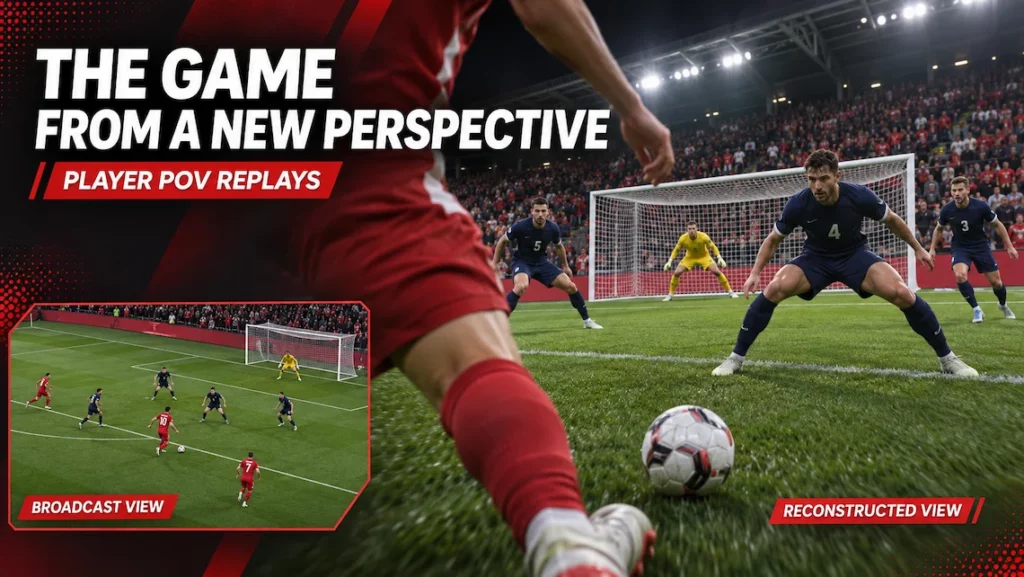
Player POV replays help explain a football moment by presenting the scene from near a selected player’s position. They can make the relationship between the ball, defenders and goal easier to discuss when the usual television angle leaves an important detail unclear.
The strongest use of a player POV football replay starts with a specific question. Why was the shooting lane so narrow? How did another player affect the route to goal? What options were visible in the reconstructed scene before the pass?
A new viewpoint is useful when it helps the audience follow that explanation. The original camera footage remains important because it establishes the action and provides the context for interpreting the added perspective.
Choose the question before choosing the angle
A goal does not automatically need a POV sequence. Sometimes the main camera already shows the relevant movement clearly. In other cases, a closer recorded angle can explain the incident without a reconstruction.
Start by identifying the detail that is difficult to understand. That might be the space between two defenders, the position of an attacker receiving the ball or the bodies between a goalkeeper and a shot.
Then ask whether a player perspective is likely to make that detail clearer. If the proposed view removes useful context or introduces more confusion, it may be the wrong angle for the discussion.
| Question for the analyst | Perspective worth assessing | What the audience should be able to follow |
| How much room was available for the shot | An attacking perspective | The relationship between defenders and the shooting lane |
| What surrounded the ball as it approached goal | A goalkeeper perspective | The positions of the ball and nearby players |
| How did a pass open space for a teammate | A passer or receiver perspective | The passing route and supporting movement |
| Why did an opening disappear quickly | A relevant player perspective | How the space changed as other players moved |
This table suggests editorial uses. Whether a particular view can be produced depends on the source material and the reconstruction method.
Explaining an attacking decision
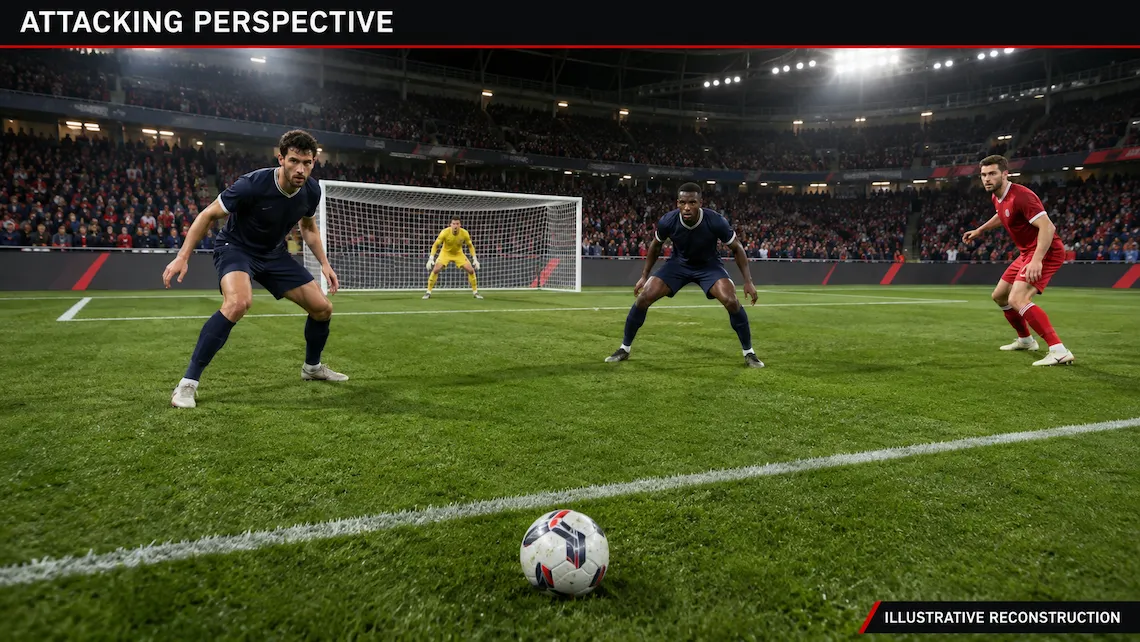
A wide broadcast shot gives viewers an overview. From that elevated position, a passing route may look obvious. A view closer to the attacker can help show how other players occupy the same area from a lower angle.
Consider a hypothetical striker receiving the ball just inside the penalty area. Two defenders are moving across the shooting lane while a teammate offers a passing option. A reconstructed perspective may help an analyst explain the available space at the selected moment.
The commentary should describe the positions and movement shown. It can discuss why a route appears narrow or how a defender closes an opening. It should avoid claiming to prove the striker’s thoughts or the exact option they consciously considered.
That boundary still leaves room for useful analysis. Viewers can better appreciate the physical situation without being told that a reconstruction reveals a player’s internal decision process.
Using a goalkeeper perspective replay
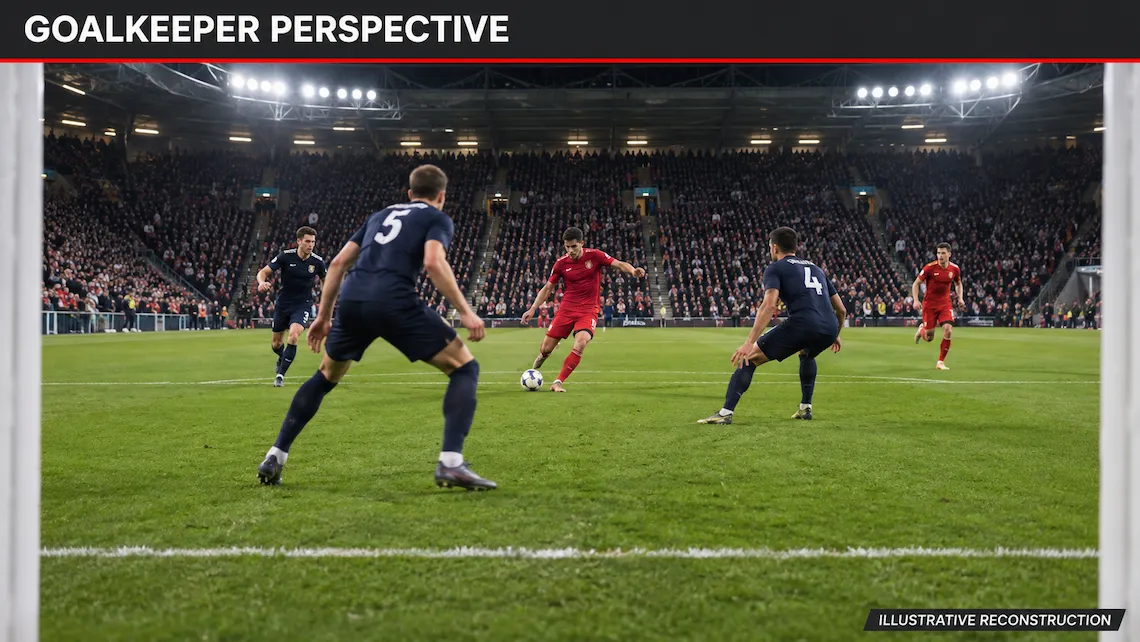
A goalkeeper perspective replay can make a crowded shooting situation easier to understand. Bodies that seem separated in a high camera view may overlap more closely when seen from near the goalmouth.
The useful question is often where the ball and other players were in relation to the goalkeeper. A reconstruction can help illustrate that arrangement and give the analyst a clearer way to discuss it.
It should not be described as a recording from the goalkeeper’s eyes. The output does not measure eye movement or establish precisely when the goalkeeper recognised a shot. A claim about reaction time would require evidence beyond a visually convincing replay.
Keep the discussion tied to what the pictures support. Saying that a player occupies part of the reconstructed view is more precise than declaring that the goalkeeper could see nothing.
Pair the POV with the original replay
A short sequence often works best when the audience sees the original action first. That establishes the ball movement, the participants and the result before the perspective changes.
The presenter can then introduce the reconstructed viewpoint and explain what to look for. One clear observation is usually easier to follow than several competing annotations.
If the segment returns to the original footage, the analyst can connect that observation to the wider move. The audience retains a sense of where the selected moment fits within the attack.
| Part of the sequence | Editorial purpose |
| Original camera replay | Establish the action and the players involved |
| Introduction to the reconstruction | Identify the new perspective and how it was produced |
| Selected POV moment | Explain the specific spatial relationship |
| Return to a wider view | Connect the detail to the complete passage of play |
This is an editorial sequence, not a fixed production specification. Its length should follow the point being explained and the available programme time.
What the original footage can help you check?
Before using a reconstruction, compare the sequence with the available recorded views. Check that the relevant movement and timing are represented consistently enough to support the intended explanation.
The ball deserves particular attention because it anchors the discussion. A perspective that makes its path difficult to follow may distract from the analysis even when the rest of the scene looks convincing.
Review the chosen freeze point as well. Freezing too late can remove the opening the analyst wanted to discuss. Freezing too early can create an impression of space that changes before the ball arrives.
The producer and analyst should agree on the claim they intend to make, then check whether the sequence actually supports it. This is especially useful when a replay is prepared for someone who was not involved in selecting the moment.
What football POV examples show in practice?
Our SPov presentation of Rodri’s winning goal in the 2023 UEFA Champions League final includes attacking and goalkeeper perspectives. It provides an example of presenting the same incident from two different positions.
The editorial question for a producer is what each perspective contributes alongside the original recording. One view may help explain the attacking situation, while another helps discuss the scene near the goal. The analysis needs to follow the actual sequence being shown.
Crystal Palace also used an SPov replay of Daniel Muñoz’s assist in its digital coverage of the 2025 FA Cup final victory. That example shows that the chosen moment does not have to begin with the scorer. A pass can be the part of the move worth revisiting.
Neither example establishes that a particular player saw or intended everything represented by a reconstructed view. Their usefulness lies in giving the audience another way to examine the action.
Keep the presentation clear
Introduce a software generated perspective as a reconstruction. Viewers should be able to distinguish it from footage captured by a camera worn by a participant.
Clear wording also helps when a clip is reused outside the original programme. A short social edit may reach someone who has not heard the presenter explain where the pictures came from. Identification should remain understandable in that context.
The same care applies to officiating discussions. A replay created for editorial explanation should not be presented as an approved measurement system or as conclusive evidence of a referee’s exact field of attention.
Build the segment around one useful observation
For a first sequence, select a moment the audience already understands in broad terms. Ask which relationship is worth examining more closely and choose a perspective suited to that question.
SPov allows us to create player perspectives from match footage without requiring a wearable camera on the player. To explore it for your coverage, share the moment you want to explain and the available source material. We can then discuss the intended viewpoint and how the output could support the segment.
Common questions about football POV analysis
Can a POV replay explain a pass as well as a goal?
Yes. A suitable perspective can help illustrate the relationship between the passer, defenders and receiver. The most useful moment is the one that supports a clear explanation. A goal may provide the outcome, while an earlier pass contains the detail worth analysing.
Should every replay use a player perspective?
No. Use it when the added view makes a particular detail easier to follow. Standard camera footage may already explain the incident well. Selecting the clearest view for the question keeps the segment focused and avoids adding a reconstruction without a useful editorial purpose.


