

Regional virtual advertising allows viewers of the same sporting event to see different sponsor messages in different broadcast markets. The match pictures remain the same, while an agreed advertising area, such as a perimeter board, carries the creative assigned to each output feed.
A domestic broadcaster might retain the branding shown inside the stadium. An international partner could receive a version with a sponsor relevant to its audience. Making that work requires a clear connection between advertising rights, creative schedules and the feeds delivered to each partner.
For rights holders, the practical question is how to keep those versions organised from production through to transmission. A regional advertisement only reaches its intended audience when the correct processed feed reaches the broadcaster serving that audience.
One match can have several advertising versions
A source feed provides the video from the event. In a programme feed, the production has already selected the shots that viewers will see. A virtual advertising workflow can process agreed areas within those pictures and produce versions carrying different advertising.
For example, the perimeter board behind a player can show one creative in Feed A and another in Feed B. The ball, players and camera movement should remain consistent. The advertising replacement needs to follow the surface and stay behind anyone passing in front of it.
The physical venue does not need to display each regional creative in turn. The change happens within the processed video. Fans looking directly at the board continue to see the creative running on the physical display.
This also explains why regional virtual advertising is usually described in terms of feeds and markets. It does not automatically provide a different advertisement for every individual viewer. The audience groups depend on the production and distribution arrangements.
How feeds are assigned to markets?
Start by listing the broadcasters and platforms that will carry the event. Establish which version each partner can receive and where that version may be distributed. A market may be a single country or a group of territories sharing one output.
The advertising plan needs to follow that actual distribution map. A sponsor cannot be promised an isolated country version if the receiving partner uses one shared feed across several countries and has no arrangement for separating them.
Feed names should identify the output consistently. If sales calls a version the European feed but distribution routes it to a different territory group, the mismatch can survive until transmission. Use the same agreed names in the creative schedule, production instructions and delivery confirmation.
| Planning item | What needs to be defined |
| Source | The agreed match feed entering the workflow |
| Output | The identity of each processed version |
| Audience | The countries or territories receiving that version |
| Receiver | The broadcaster or platform taking the output |
| Advertising schedule | The creative and timing assigned to that output |
| Alternative | The agreed version used if a processed output is unavailable |
A distribution partner should confirm receipt of the intended version during testing. Checking that a picture arrives is insufficient if the wrong advertising schedule appears in that picture.
What happens to the sponsor creative?
Each output needs approved artwork and a clear playback schedule. A regional sponsor may use a local language, a different product message or a creative designed specifically for that audience.
The same logo file may not work equally well in every placement. Long wording can become difficult to read on a distant perimeter board. Reviewing the creative at normal broadcast size gives a more useful impression than reviewing the full artwork on a design screen.
Version control becomes important as the number of outputs grows. The person approving the creative should be able to identify its sponsor, destination feed and current revision. If a brand changes its wording shortly before the match, the team needs to know which outputs are affected.
Creative approval and scheduling approval are separate decisions. Artwork can be visually correct while being assigned to the wrong territory or time slot. A final check should cover both.
An example with three broadcast markets
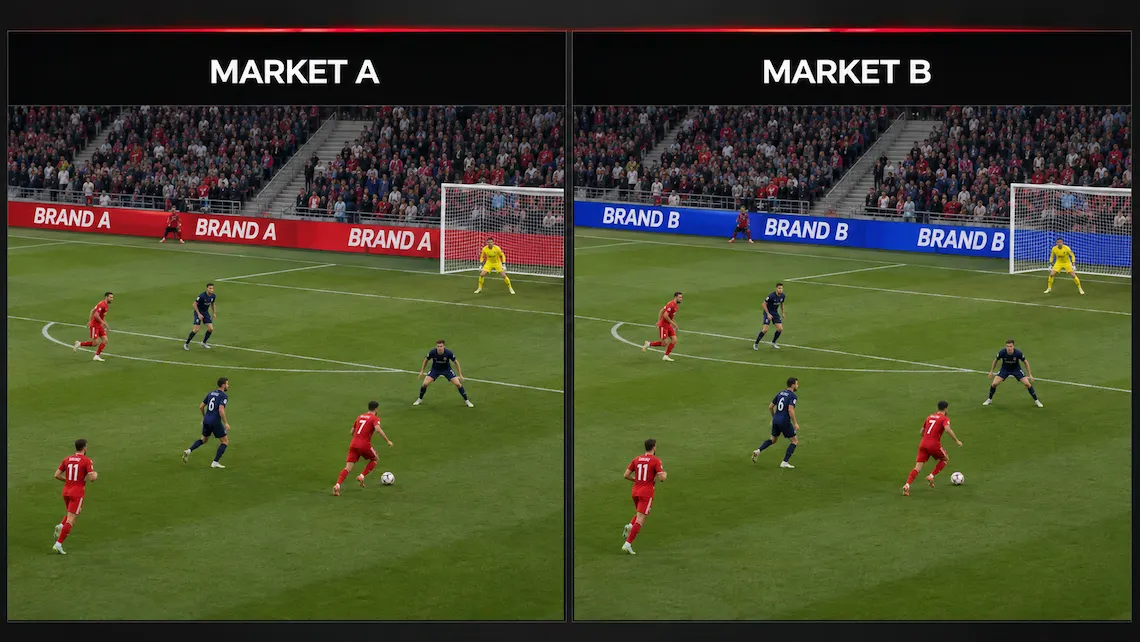
Consider a hypothetical football fixture with one domestic output and two international versions. The rights holder has permission to retain the stadium sponsor domestically and replace the agreed perimeter area in two overseas markets.
| Version | Advertising treatment | Intended distribution |
| Domestic | Retain the physical perimeter branding | The domestic broadcast partner |
| International A | Apply the creative approved for Sponsor A | The partner serving Market A |
| International B | Apply the creative approved for Sponsor B | The partner serving Market B |
The same underlying match can support all three versions, but the commercial commitments differ. Sponsor A’s exposure should be reported against the output carrying Sponsor A. The total audience of every version should not be presented as that sponsor’s delivered audience.
The plan also needs to address what happens outside the live programme. If the club publishes a goal clip taken from International A, Sponsor A’s creative may remain in the picture. That use needs to fit the rights and distribution terms for the clip.
This example describes a possible arrangement, not a standard package that every event can provide. The available versions depend on the event’s rights, technical scope and distribution partners.
Agree the rights before building the feed plan
An advertising surface can carry several overlapping commitments. The venue may have a physical display sponsor, while a league, federation or broadcaster controls particular commercial rights around the event.
Those commitments need to be reconciled before virtual replacement is sold. A brand’s category exclusivity may also affect which advertisers can appear in a regional version. Replacing the image does not remove the underlying agreement.
The rights discussion should cover the intended territories, supported placements and publication formats. Live television, streaming, highlights and social clips may have different terms. An international feed should not be treated as a blanket permission for every later use of its pictures.
Documenting the permitted uses helps the production team respond when a new output is requested. It gives them a concrete scope to check rather than relying on an informal understanding made during the sales process.
Check picture quality and feed routing together
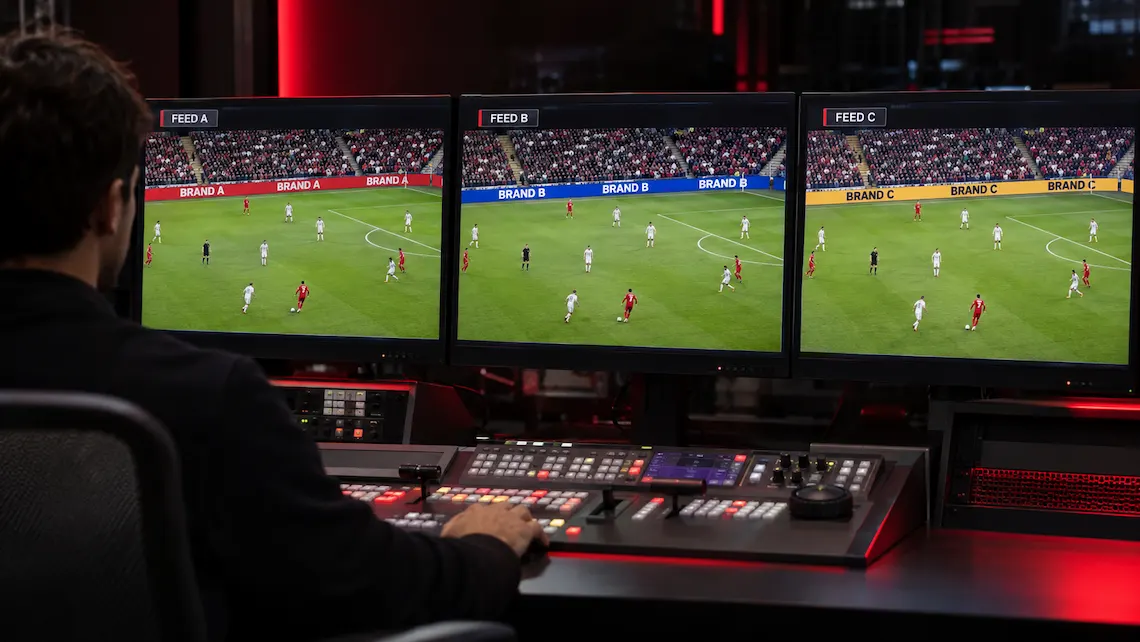
Multi feed virtual advertising needs two kinds of checking. The advertisement must look correct within the picture, and the correct advertisement must appear in the correct output.
Picture review should include camera movement, changes of view and foreground objects crossing the placement. Camera coverage should be agreed explicitly, including any replay views that form part of the service.
Routing review checks the identity of each output and its destination. A perfectly aligned advertisement still fails the commercial brief if it reaches the wrong market.
Before transmission, run a rehearsal that includes a creative change and a handoff to the receiving partner. Agree who can authorise a correction and what happens if one regional version needs to stop while other versions continue.
Reporting regional sponsorship delivery
Keep a record of the creative assigned to each version and the available evidence of its delivery. Useful records can include output recordings, schedule logs and confirmation from the relevant receiving partner, depending on the agreed reporting process.
Distinguish delivery from audience measurement. A recording can show that a creative appeared in an output. It does not, by itself, establish how many people watched that output or how the exposure affected sales.
This distinction makes regional sports sponsorship easier to discuss at renewal. Both sides can compare the promised inventory with the delivered material, then assess audience and campaign performance using the appropriate additional data.
Regional virtual advertising with SPboard
Our SPboard technology supports software based advertising replacement and regional broadcast versions. A practical example is our Morocco versus Ecuador deployment in Madrid, where separate signals carried advertising tailored to South American and African audiences.
That project illustrates the relationship between a shared live production and different commercial versions. Its exact setup should not be assumed for another fixture without reviewing the new requirements.
To plan a regional advertising project with us, start with the event, target territories, available rights and receiving broadcasters. Those details provide a useful basis for reviewing the required outputs and arranging a relevant demonstration.
Common questions about regional virtual advertising
Does each regional feed need a separate camera crew?
Regional versions can be produced from shared match pictures, depending on the solution and agreed workflow. Different advertising outputs do not inherently require separate crews filming the same action. The source feed and supported camera coverage still need to be assessed for the event.
Can the original advertising remain in one version?
Yes, a production plan can retain the original appearance in one version while applying approved replacements to others. The arrangement needs to match the advertising rights, output routing and distribution plan. It should be established before sponsors are promised particular exposure.


