
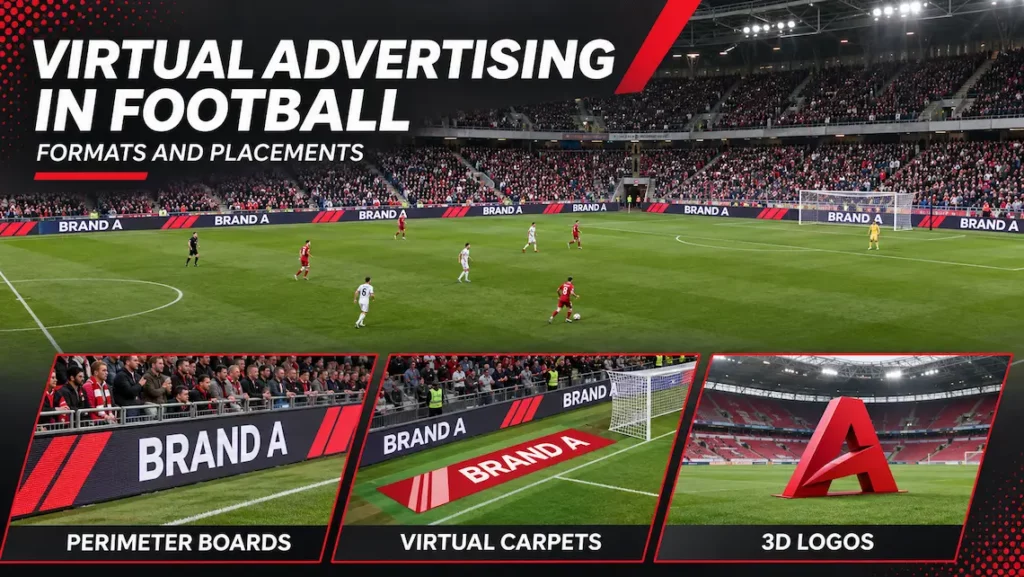
Virtual advertising in football can replace the appearance of existing perimeter boards or introduce approved sponsor placements into the broadcast picture. Common formats include banner replacement, virtual signage, virtual carpets and 3D sponsor logos.
The format describes how the creative appears. The placement describes where it appears within the match coverage. Choosing both together helps a commercial team offer an exposure that the production can actually deliver.
For example, a perimeter replacement seen regularly in wide match shots serves a different purpose from a sponsor logo introduced during a selected programme moment. The right choice depends on the intended audience, available rights and camera views.
Perimeter banner replacement
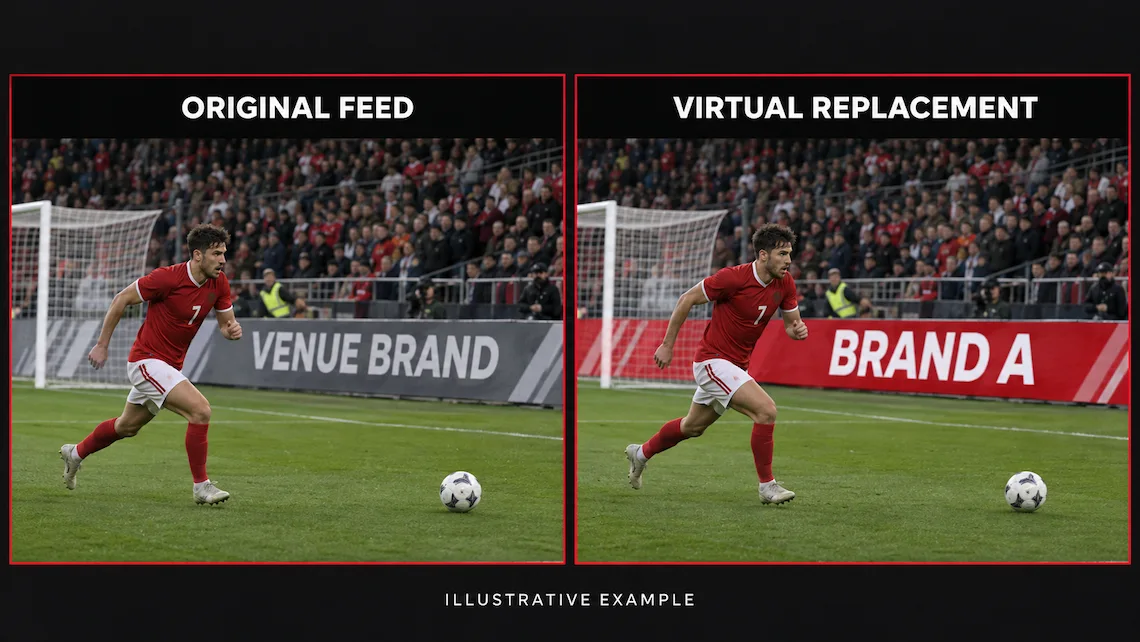
Perimeter replacement changes the advertising shown on an existing board within a processed video feed. The physical display can continue running its venue schedule while viewers of an agreed broadcast version see another creative.
Its appeal is familiarity. The advertisement occupies an area viewers already associate with sponsorship. When the placement follows the camera correctly and foreground objects remain visible, it can sit naturally within the coverage.
The production scope still matters. A successful replacement in the main camera view does not establish that every close view, reverse angle or replay is supported. The team should identify the views included in the project before selling the exposure.
A second row of boards can provide another position where the setup supports it. Its value needs to be assessed at actual broadcast size because a more distant surface may make smaller artwork difficult to read.
Virtual signage
Virtual signage is a broader description for sponsor branding inserted into a suitable part of the broadcast scene. It may resemble a conventional sign even when an equivalent physical advertising object has not been installed there.
The placement needs to make visual sense from the camera’s perspective. Its scale and position should fit the scene, and it should not cover the play or useful programme information.
For commercial planning, describe the position precisely. The term virtual signage alone does not tell a sponsor how large the creative will appear, which shots will contain it or how often those shots are likely to be used.
The distinction between inventory and exposure is useful here. A position can be technically available without receiving a predictable amount of screen time. Any commitment about delivery needs a separate basis.
Virtual carpets and 3D carpets
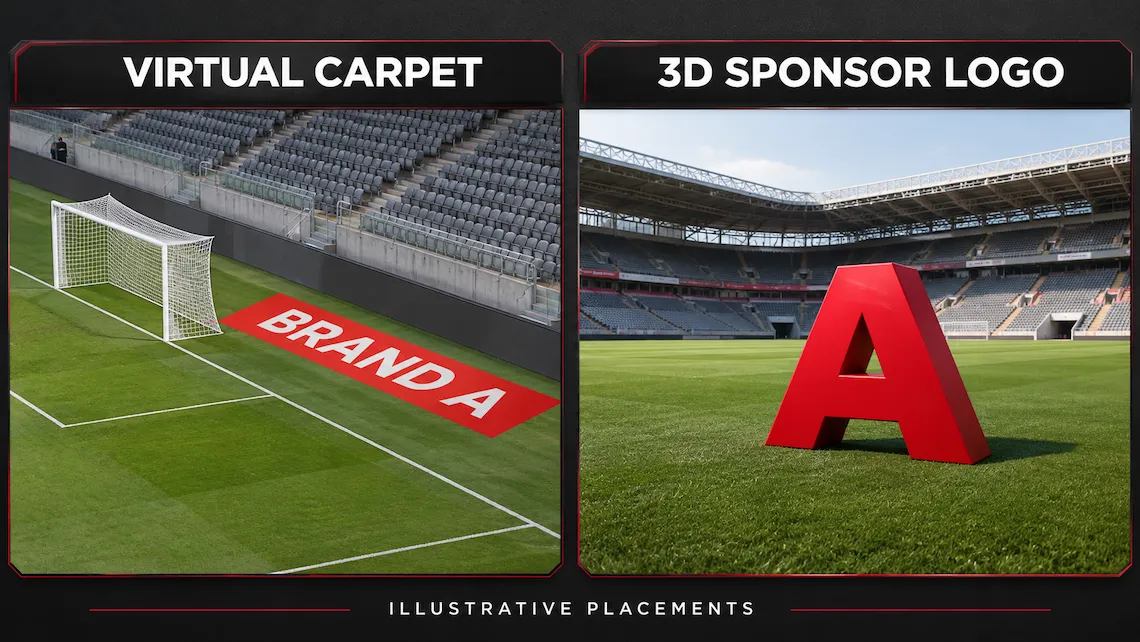
Virtual carpets create an advertising placement that appears to lie on a surface within the televised scene. A design can be adjusted for the relevant camera perspective so that the branding reads clearly in that view.
In football, carpet style placements are often discussed around areas beside the playing action or near the goal, subject to the competition and production arrangements. The name describes the visual effect. It does not mean a physical mat has been placed on the pitch.
A camera change can alter how that design should appear. The planning discussion should therefore cover which views support the placement and whether it remains active when the programme cuts away.
Creative should be reviewed in the intended shot. A design can look attractive on a flat artwork file and become cramped or distorted when placed in perspective within the actual broadcast frame.
3D sponsor logos
A 3D sponsor logo uses depth and perspective to give a brand a more dimensional appearance within the scene. It can be suited to selected programme moments where the production has time to introduce and frame the placement.
The visual treatment should support the coverage. Large graphics can draw attention, but they also require enough clear space and suitable timing. A logo that competes with an important passage of play can make the picture less useful to viewers.
Before approving the concept, review the complete frame with the match graphics included. Score displays, captions and other elements may occupy space that looked available in a clean demonstration.
The wording 3D does not automatically imply an interactive experience for the viewer. The output may simply be a produced graphic presented within a normal television picture.
Comparing the main formats
| Format | Typical visual treatment | Main planning question |
| Perimeter replacement | Different creative on an existing board area | Which camera views and regional outputs are supported |
| Virtual signage | A sponsor sign within an approved scene area | How the position fits the view and available rights |
| Virtual carpet | Branding appearing to sit on a surface | Whether the artwork reads correctly from the intended angle |
| 3D sponsor logo | A dimensional brand graphic within the scene | When it can appear without competing with the action |
Regional advertising can apply to suitable formats within the agreed scope. It is a way of assigning creative to audiences, rather than a separate physical position in the stadium.
Match the placement to the camera coverage
Start with the shots the director actually uses. A location visible in the main wide camera can have a different role from one seen primarily during a close view of the bench or a goalmouth replay.
Review representative footage with the commercial team. Identify where the creative appears, how much of it remains visible and whether foreground players frequently cross it. That makes the inventory easier to explain to a sponsor.
Camera movement also affects the evaluation. The advertisement needs to remain aligned as the picture pans or zooms. A player crossing the area should remain naturally in front of the placement.
Replays deserve their own discussion. Coverage of a placement in the live camera sequence does not guarantee that every replay angle will receive the same treatment. Agree the supported use rather than assuming visual continuity across every shot.
Examples from SPboard projects
During the Emaar Cup match between Shabab Al Ahli and Al Wasl in December 2024, our SPboard deployment included advertising positions around the centre circle, offside line areas and near the benches. The project illustrates why a placement needs to be considered within the actual production.
Those positions describe that deployment. They are not a promise that every event can use identical inventory during any phase of play. The competition, rights and intended programme treatment determine what can be offered.
Our Morocco versus Ecuador project in Madrid provides another example. Its advertising scope included replacement of first and second LED rows and 3D carpet integrations, with separate signals serving two regional audiences.
Together, the examples show the difference between choosing a format, selecting a position and assigning creative to an output. Each decision needs to fit the same production plan.
Decide what the sponsor is buying
A commercial description should identify the placement and its delivery scope. Naming a format is only the start. The sponsor also needs to understand which markets, programme uses and supported views are included.
| Detail to agree | Why it matters |
| Placement and format | Defines the advertising inventory |
| Broadcast versions | Identifies the audience groups receiving the creative |
| Supported camera views | Sets realistic expectations about visibility |
| Timing and scheduling | Explains when the placement can be used |
| Highlights and later clips | Clarifies the scope beyond live coverage |
| Reporting method | Establishes what evidence of delivery will be supplied |
Avoid treating every technically possible position as an additional item of saleable inventory. The available rights and the value to the audience still need to support it.
Keep artwork readable and the match visible
A clear logo or short message is often easier to follow than several small lines of copy. Review the creative at the size a viewer is likely to see, including on a smaller screen.
Check it during normal camera movement as well as on a still frame. The advertisement should remain understandable without requiring the viewer to look away from the match for an extended period.
The same principle applies to animation. Its use needs to suit the format and production instructions. A placement should not obscure the ball, important player movement or programme graphics in pursuit of more attention.
Planning football virtual advertising with SPboard
With SPboard, we provide software based virtual advertising formats for sports coverage. For a football project, bring the intended markets, representative footage and the inventory you are considering.
That gives us a practical basis for reviewing the placement options and preparing a demonstration relevant to your production. The resulting plan should describe what can be delivered clearly enough for both the broadcaster and sponsor to use.
Common questions about football advertising formats
Is a virtual carpet a physical object on the pitch
No. The virtual placement is created within the broadcast image. Its appearance is designed for the relevant camera view. Spectators looking directly at the venue do not see a physical carpet as a result of that insertion.
Can several virtual formats be used in one match
They can be combined when the technology, rights and production plan support them. The scope should identify each placement and its supported use. Combining formats does not remove the need to preserve the action and check how each one appears in the programme.


