

Virtual advertising works by adding or replacing advertising inside a sports broadcast feed. Software places the selected creative into the picture and adjusts it as the camera moves, so the advertisement appears attached to a board or another approved surface. Viewers watching different regional versions of the same match can then see different sponsors in the same position.
The physical stadium does not have to change when the broadcast advertisement changes. Someone sitting behind the goal may see one sponsor on the perimeter boards, while someone watching an international feed sees another. Both audiences are watching the same action.
For a broadcaster or rights holder, understanding how virtual advertising works in sports starts with the feed itself. The important questions are which pictures will be processed, which advertising rights are available and how each version will reach its intended audience.
What virtual advertising changes in a sports broadcast?
A conventional perimeter advertisement is part of the scene a camera records. Virtual advertising changes the appearance of an agreed advertising area in the video, allowing a different creative to appear in the distributed picture.
Replacing an existing banner is one use. Another is introducing an approved virtual placement into an area that did not previously carry a physical advertisement. The available formats depend on the sport, camera coverage and production setup.
This is different from putting a sponsor logo in the corner of the screen. A screen graphic can stay fixed while the camera moves. An advertisement placed on a perimeter board needs to follow that board, including changes in its apparent size and angle.
| Element | Physical advertising | Virtual advertising |
| Advertising location | A real display or surface at the venue | An approved area within the broadcast picture |
| What spectators see | The creative displayed at the venue | No direct change to their view of the venue |
| What broadcast viewers see | The advertisement captured by the camera | The creative assigned to their processed feed |
| Regional versions | The physical display itself does not assign different feeds | Different processed feeds can carry different creative |
From the incoming feed to the viewer
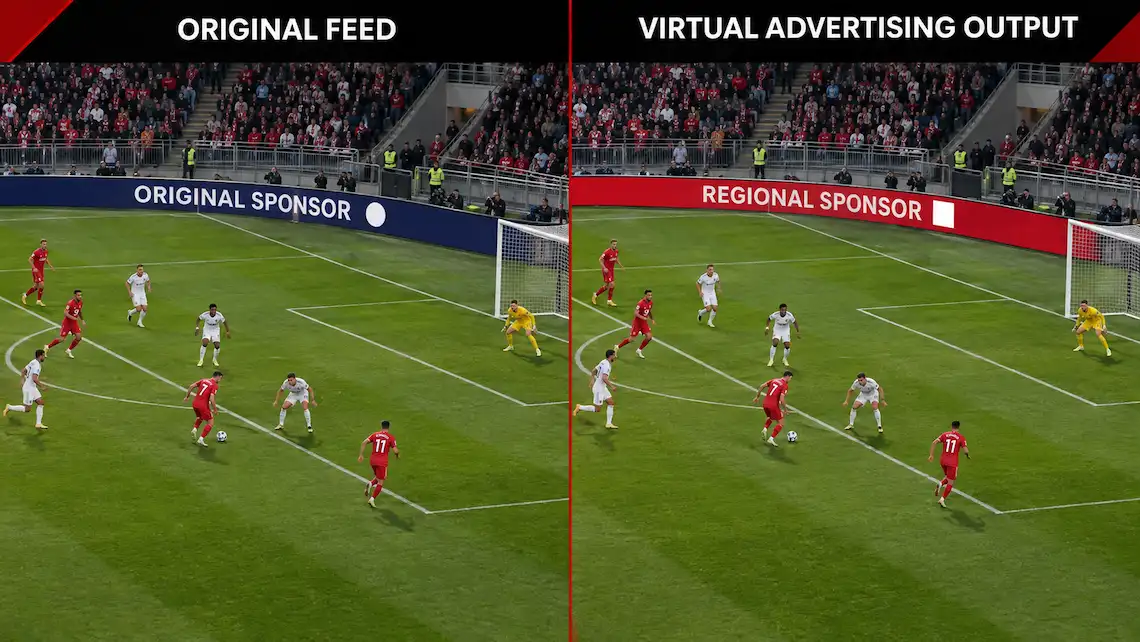
The exact workflow varies between providers. A useful way to understand virtual advertising in sports is to follow the picture through production, processing and distribution.
Agree the advertising inventory
Before processing begins, the commercial and production teams need a shared definition of what can be replaced or added. That includes the positions, applicable camera views, markets and sponsor categories.
A board being visible on television does not automatically mean it is available for virtual replacement. Existing sponsorship agreements and distribution rights still apply. The technical ability to alter a picture and the commercial right to sell that placement are separate questions.
Receive the agreed source feed
The virtual advertising system receives the source video specified for the production. Depending on the setup, processing may connect to the venue production or take place remotely using a supplied feed.
The team needs to know what arrives in that feed. Score graphics, camera cuts, existing sponsor graphics and replay sequences can affect how the system is integrated. Feed format, transport and timing also need to be agreed before the event.
Identify and follow the placement
The system must locate the advertising area and keep the replacement aligned as the shot changes. In software based approaches, computer vision can help analyse the picture and follow the relevant surfaces.
Consider a camera panning towards a player taking a corner. The perimeter board shifts across the image and changes shape from the viewer’s perspective. The virtual advertisement needs to move and scale with it. Otherwise, it appears to slide across the scene.
Combine the creative with the match picture
The selected sponsor creative is combined with the video. Good compositing preserves the relationship between the advertisement and the objects in front of it.
If a player runs past a board, the player should remain visible in front of the replacement. The same principle applies to a ball, an official or another object crossing the advertising area.
Deliver each approved output
The processed output is routed into the agreed distribution path. A single event may have several versions, each with a different advertising schedule for a particular market or group of markets.
That makes feed identification important. The correct creative has to reach the correct output, and the receiving broadcaster needs to know which version it is using.
Why tracking and occlusion matter?
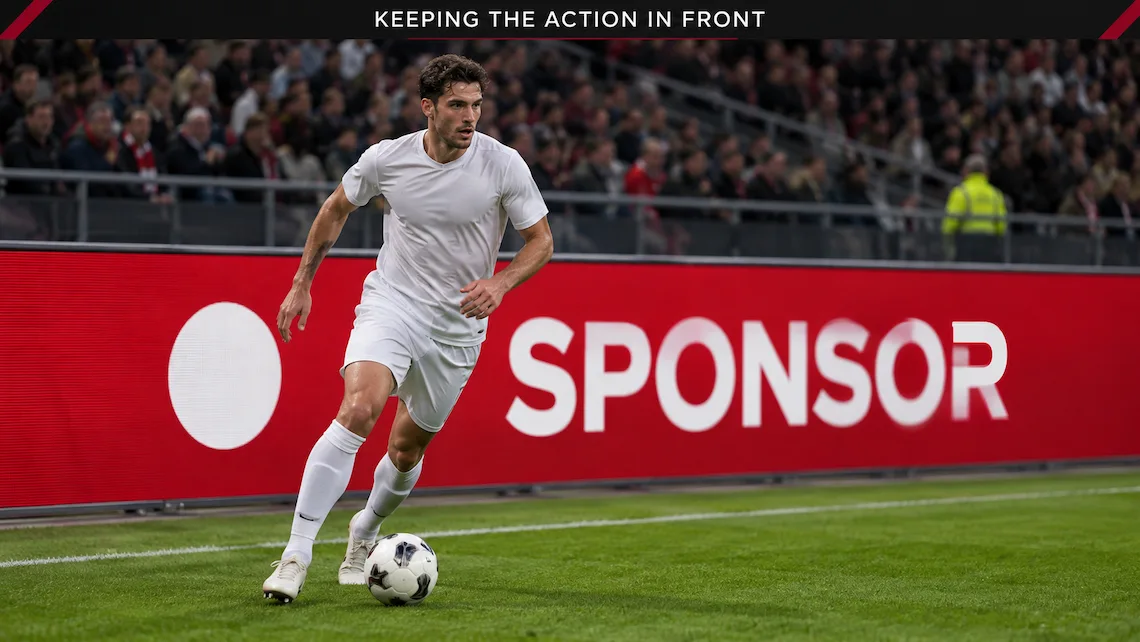
Most viewers will never use the word occlusion. They will notice when a virtual advertisement covers a player’s arm or when its edge jumps during a zoom.
Occlusion describes an object blocking something behind it. In sports advertising, managing it correctly means preserving the foreground action while changing the advertising surface behind it.
Tracking handles a related problem. The placement needs to remain attached to the scene throughout camera movement. Perspective describes how that placement should look from the current camera angle.
| Quality consideration | What it means | What to watch for |
| Tracking | The placement follows the relevant surface | Logos drifting or jumping during a pan |
| Perspective | The creative matches the angle of the surface | A replacement looking flat or incorrectly stretched |
| Occlusion | Objects in front remain in front | Advertising appearing over players or the ball |
| Visual continuity | The result remains consistent as the shot develops | Sudden changes at cuts, zooms or the edge of a placement |
A useful demonstration should include ordinary match conditions as well as clean, static shots. Players gathering near a board, fast camera movement and close views of the advertising area reveal different parts of the system’s behaviour.
How different regions can see different sponsors?
Regional virtual advertising allows the same sporting event to carry different advertising creative in different broadcast versions.
For example, a rights holder could agree one sponsor for a domestic feed and a different sponsor for an international territory. The relevant advertisement is applied to each version before that version reaches its distribution partner.
This is targeting at the level of the feed or market. It does not automatically mean that every individual viewer receives a personalised advertisement. The level of targeting depends on how the content is processed and distributed.
The commercial benefit is the ability to offer advertising that better matches the audience a sponsor wants to reach. Realising that benefit still requires suitable demand, available rights and a reliable delivery plan. More outputs alone do not guarantee more revenue.
Where virtual advertisements can appear?
Perimeter banner replacement is a familiar example, particularly in football. Other formats can include virtual signage, virtual carpets and sponsor logos placed within approved parts of the picture.
Each format needs its own production assessment. A placement that works well from a wide camera angle may be unsuitable for another view. Creative also needs to stay readable within the actual television frame, rather than only looking good as a full size design file.
The commercial team should therefore develop the inventory with production staff. That makes it easier to promise placements that the broadcast can actually deliver.
What broadcasters need to plan before an event?
The first rehearsal should answer practical questions about the complete signal path. Who supplies the source? Who checks the output? Who decides whether an advertisement should be removed when a shot becomes unsuitable?
Creative approval matters too. A sponsor’s logo may be clear in a presentation but difficult to read on a distant board. Reviewing artwork at its expected screen size can prevent avoidable changes on match day.
| Planning area | Question to settle |
| Rights and markets | Which placements and territories are included in the agreement |
| Source video | Which feed and camera views will be supported |
| Creative | Who approves artwork, scheduling and regional versions |
| Timing | How processing fits the broadcast’s timing requirements |
| Quality control | Who monitors the result and handles exceptions |
| Continuity | What output is used if virtual insertion needs to stop |
Remote operation can reduce the need for additional activity at the venue, depending on the solution. It still requires coordination between the people providing the pictures, operating the advertising system and distributing the output.
Where SPboard fits?
SPboard is SponixTech’s software based virtual advertising solution. It supports regional advertising versions and formats including banner replacement, virtual signage and virtual carpets, using existing broadcast and venue setups.
For a project team, the next step is to review the intended sport, available feed and commercial inventory together. A demonstration using relevant footage is more useful than evaluating a placement without knowing how it will be produced or sold.
Common questions about virtual advertising in sports
Do fans in the stadium see the virtual advertisement?
The virtual insertion changes the processed broadcast picture. Fans looking directly at the pitch or physical boards continue to see the venue itself. A screen inside the stadium could show a processed feed, but that depends on the production and screen distribution arrangements.
Does virtual advertising require new cameras?
Some solutions can work with existing camera setups, while others have different integration requirements. The supported camera views, input format and operational needs should be checked for the specific system. Software based operation does not remove the need to agree a suitable source feed.
Can virtual advertisements appear in highlights?
They can, where the solution, footage and rights support that use. Teams should establish whether the highlight is taken from an already processed feed or whether advertising is applied separately. Regional rights and sponsor commitments may also differ between live coverage and later clips.
How should a broadcaster assess a virtual advertising demo?
Use footage similar to the planned event and check camera movement, foreground objects, cuts and creative readability. Then review how the output reaches the broadcaster. Picture quality and reliable production both matter when deciding whether the solution fits the event.


