
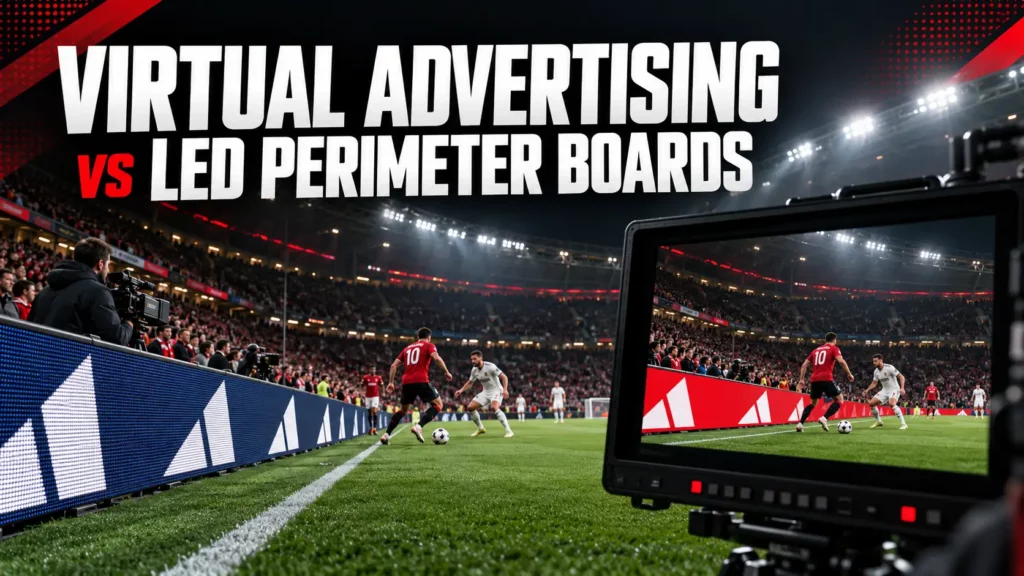
Virtual advertising changes the advertisement shown inside a broadcast picture. LED perimeter boards display advertising on physical screens at the venue. The two can work together, with the stadium audience seeing the physical board and a regional broadcast audience seeing a different advertisement in the same position.
That is the main distinction in a virtual advertising vs LED boards comparison. One determines what a real display shows. The other changes an agreed part of the video being distributed.
For a club, league or sponsor, the right choice depends on the audience the campaign needs to reach. A sponsor seeking visibility inside the stadium has a different requirement from a brand buying coverage in one overseas broadcast market.
What LED perimeter advertising does?
LED perimeter boards are physical electronic displays positioned around the playing area. Operators schedule creative on the boards, and spectators can see that creative directly. Broadcast cameras also record it whenever the boards appear in a shot.
The display can rotate between sponsors and show moving creative. This gives the venue control over its physical advertising schedule, subject to competition rules and commercial agreements.
Ordinary LED playback does not, by itself, assign a different sponsor to each regional television feed. The camera captures the display operating at the venue. Any specialised system designed to create distinct camera outputs needs to be assessed separately from a standard LED installation.
What virtual advertising changes?
Virtual advertising introduces or replaces creative within the video feed. For perimeter advertising, the software can make the board appear to carry different branding in an approved broadcast version.
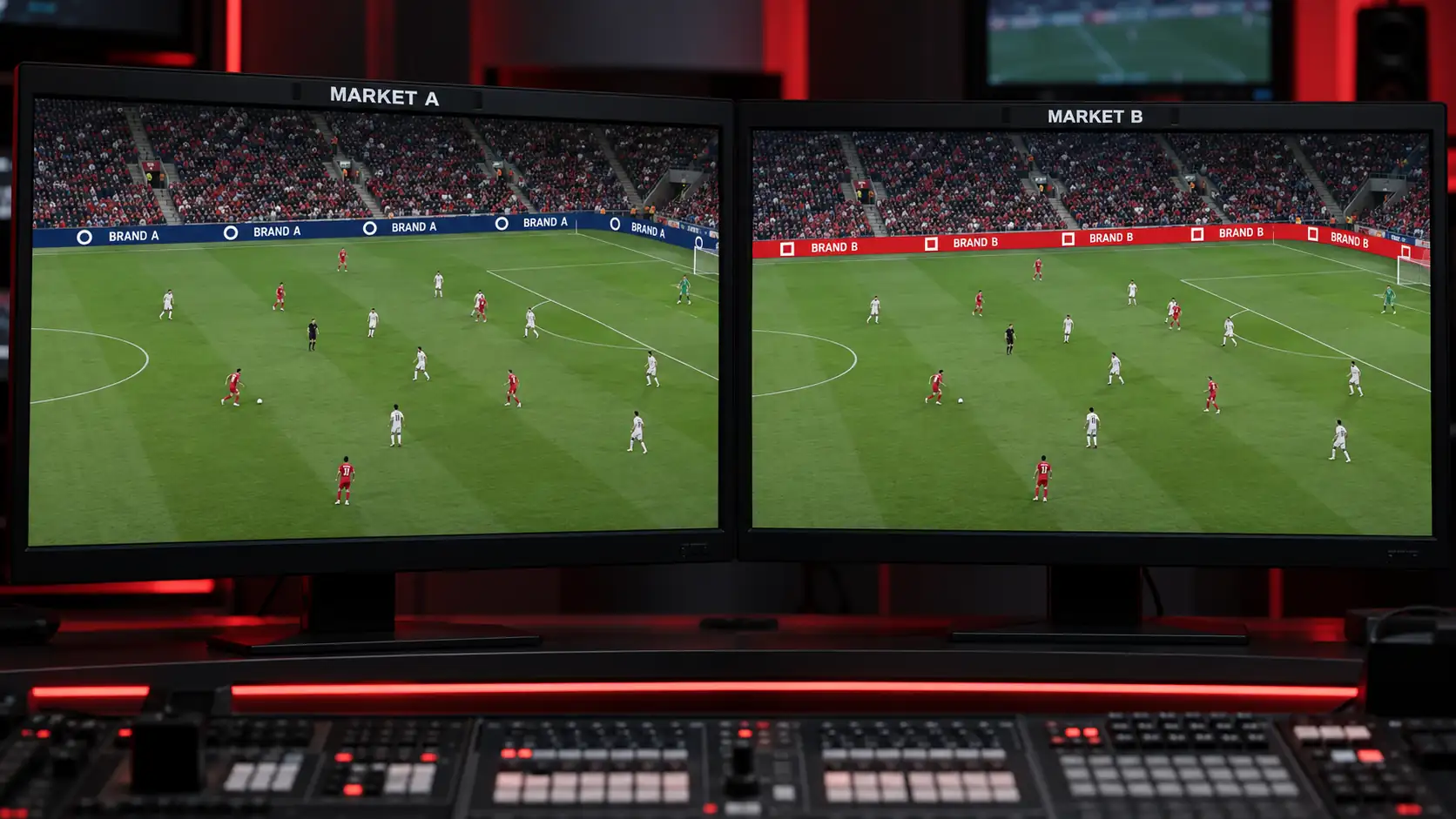
The physical board may continue showing its scheduled sponsor while a processed feed shows a creative intended for another market. Regional virtual advertising therefore adds control over the distributed picture, rather than changing what a spectator sees by looking at the board.
It can also support approved placements beyond physical perimeter replacement, depending on the solution and production setup. A virtual carpet, for example, is a different inventory format from an LED board.
Virtual advertising and LED boards compared
| Consideration | LED perimeter boards | Virtual advertising |
| Where the advertisement exists | On a physical screen at the venue | In the processed broadcast picture |
| Stadium visibility | Visible directly to spectators with a view of the board | Does not directly change the physical venue |
| Broadcast visibility | Visible when a camera records the display | Visible in the processed feeds and supported views |
| Regional creative | A standard physical display does not independently assign creative by feed | Different processed versions can carry different creative |
| Main operational work | Display operation, creative scheduling and venue maintenance | Feed processing, creative scheduling and output monitoring |
| Camera coverage | Depends on the board appearing in the recorded shot | Depends on supported views and approved placements |
| Commercial scope | Physical exposure and the agreed broadcast use of that display | The markets, feeds and uses included in the virtual rights |
| Main quality concerns | Display readability and how the camera captures the screen | Alignment, perspective, occlusion and continuity |
This comparison describes the basic difference between physical displays and broadcast insertion. Individual installations may combine more than one technology.
What each audience actually sees?
Consider a hypothetical international football fixture. A domestic sponsor buys physical perimeter exposure, while an overseas sponsor buys an approved regional broadcast placement.
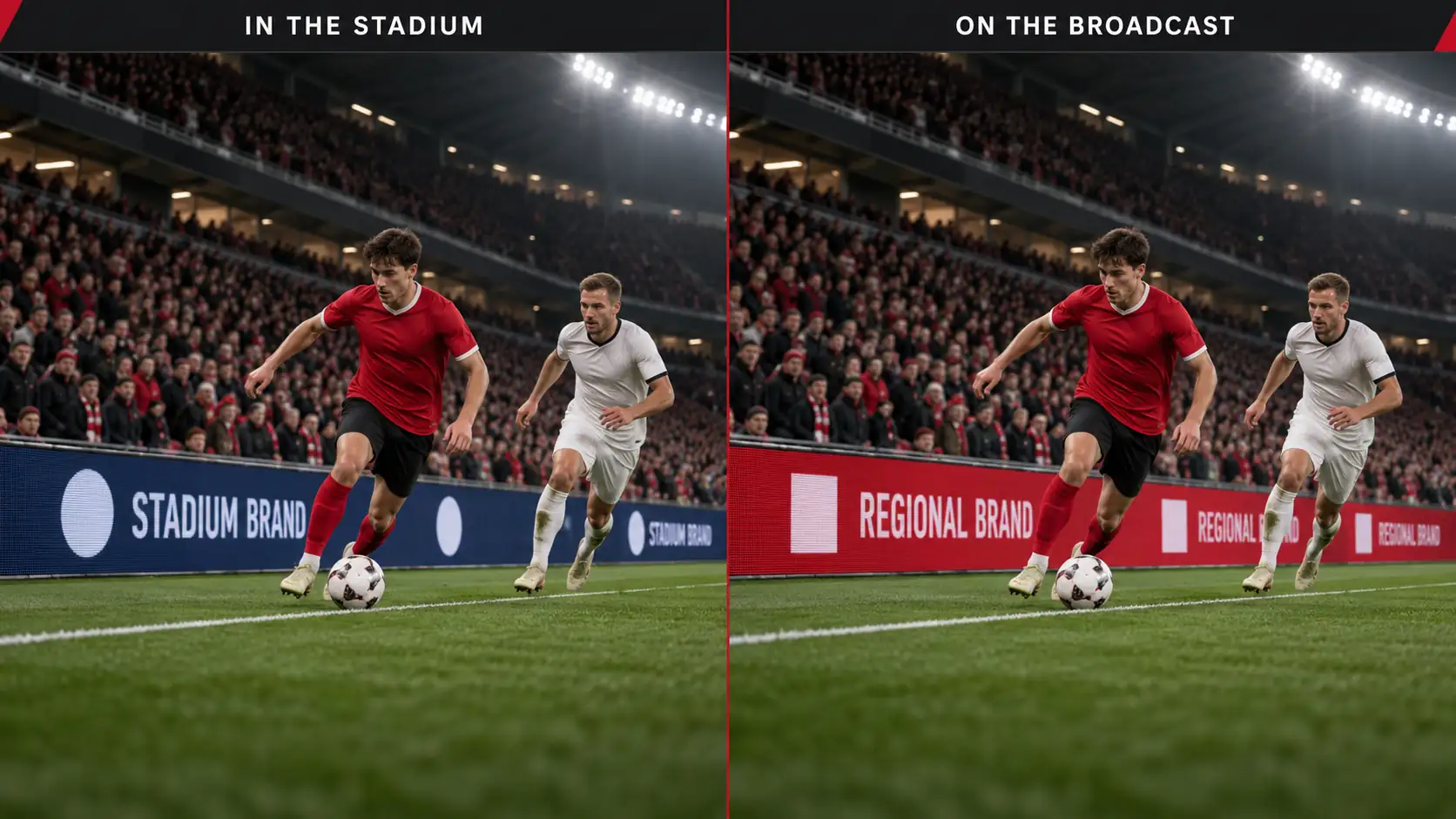
Fans inside the stadium see the domestic sponsor’s creative on the LED boards. Viewers receiving an unmodified camera feed see that creative when it appears in shot. Viewers receiving the selected processed regional version can see the overseas sponsor in the agreed advertising position.
This arrangement needs clear contracts. The rights holder should define whether the physical sponsor’s agreement includes particular broadcast territories and whether virtual replacement is permitted. A technically workable replacement can still conflict with a commercial commitment.
The same clarity is needed for highlights. A clip taken from one regional feed may contain advertising that was only cleared for that market. The distribution plan should explain which version is suitable for later publication.
How the production requirements differ
Operating the physical display
An LED installation needs suitable infrastructure, control equipment and creative that works on the available display. The venue team is responsible for the physical operation and scheduled playback.
Production staff should also review how the display appears on camera. Brightness, screen behaviour and camera settings can affect the recorded image. A board that looks clear to a spectator still needs to perform well in the broadcast picture.
Operating the virtual placement
A virtual advertising workflow needs an agreed source feed, supported camera views and a defined output path. The system must keep the creative attached to the intended surface while preserving objects that pass in front of it.
The operator also needs a plan for exceptions. A camera cut, an unsuitable view or a processing issue should not leave the director uncertain about which output is available.
Software based virtual advertising can work with existing venue equipment, depending on the solution. The absence of a new physical display does not mean the broadcast integration can be skipped.
Which approach offers better value?
There is no useful universal price comparison without knowing the event and the rights being sold. A venue considering new screens is making a different decision from a league that already has LED boards and wants regional advertising versions.
LED costs can include the display, installation, control equipment, power, maintenance and operation. Virtual advertising costs can include service delivery, integration, the number of outputs, production support and creative management.
For an existing LED installation, the more relevant question may be whether virtual replacement adds commercially viable inventory. That depends on advertiser demand and available rights, as well as the cost of delivering each version.
| Commercial objective | Approach worth assessing |
| Reach spectators inside the venue | Physical LED exposure |
| Maintain a visible local sponsor presence | LED scheduling and the relevant sponsorship agreement |
| Offer different messages in different broadcast markets | Regional virtual advertising with appropriate distribution |
| Extend the use of existing perimeter inventory | A combined physical and virtual advertising plan |
| Add an approved placement without installing another display | A suitable virtual format |
When LED boards and virtual advertising work together?
The two approaches can support different parts of the same sponsorship strategy. LED boards serve the venue experience and provide a physical advertising surface. Virtual replacement can adapt the television appearance of that surface for agreed markets.
This can be useful when a competition has meaningful audiences in several territories and sponsors whose priorities differ between those territories. It is less compelling when the additional outputs have no realistic buyers or cannot be distributed as planned.
Start with the audience and the rights. Then decide what technology is needed to deliver the promise being made to each sponsor.
What to check before committing to a setup?
Ask to see the intended camera views rather than only a close view of the creative. Review how the branding appears at normal broadcast size, especially during movement and when players cross the advertising area.
The commercial review should be equally specific. Identify the territories, applicable feeds, sponsor categories, highlight rights and reporting commitments. Avoid selling the same exposure twice under incompatible agreements.
SPboard provides software based virtual advertising alongside existing camera and perimeter setups. For a team already using LED boards, the useful question is which regional broadcast opportunities can be added within its existing rights and production plan.
Common questions about virtual advertising vs LED boards
1. Can virtual advertising replace the need for stadium LED boards?
It can provide approved broadcast placements without an equivalent physical display in some situations. It does not provide the same direct visibility to people attending the event. A venue choosing equipment should consider its stadium objectives separately from its broadcast advertising objectives.
2. Do virtual advertisements appear in every camera angle?
Coverage depends on the system and agreed production scope. Ask which cameras and shot types are supported, including close views and replays. Do not assume that a successful replacement in the main wide shot establishes support for every camera used in the programme.
3. Can the physical sponsor remain visible in one market?
Yes, the output plan can retain the original appearance in one feed while applying approved replacements elsewhere. The arrangement depends on the processing workflow, distribution and commercial agreements. Physical and virtual rights should describe the exposure each sponsor is buying.


